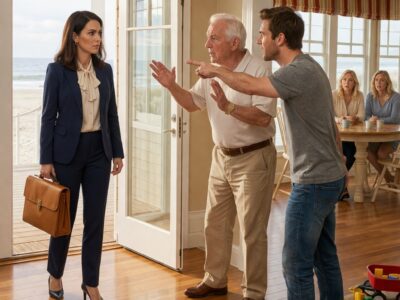
“Because you loved me according to my usefulness,” I said. “And I wanted to know if there was anything underneath that.”
Her face tightened. “That isn’t fair.”
I almost smiled.
Fair.
From her.
“I lived in your basement for three years,” I said. “Paid you rent. Repaired your furnace. Fixed your sink. Took your insults. Watched you throw a cake in the trash because it didn’t come from a bakery with a gold logo on the box. You told me I was cursed. You called me invisible. You let him”—I nodded once toward Jace—“talk about me like I was the hired help who forgot his place. You threw me out to protect the image of your lawn.”
My father stood too quickly, wobbling once before catching himself on the chair arm. “You can’t come here and speak to your mother that way.”
I turned to him. “I can speak any way I want. I don’t live under your floor anymore.”
That hit him harder than the acquisition had.
Because people like my father survive on the old architecture of obedience long after the structure itself is gone. Take away his financial leverage, his roof, his authority to make me small in front of others, and he had very little left except bluster and the faint smell of failure.
Jace recovered enough to scoff. “So what, you hit the lottery or something and now you think you’re God?”
I looked at him.
“That’s exactly what happened.”
He blinked. Hard.
My mother made a tiny involuntary sound. My father gripped the chair back with both hands.
I kept going because there was no point in preserving anyone now.
“Three years ago I won four hundred and fifty million dollars,” I said. “After taxes I kept about two hundred and eighty. I put it into a blind trust because I knew exactly what kind of family I had. Then I waited. And watched. And paid attention.”
Arthur Wexley had gone pale with fascination.
The developer beside him looked like he wished very badly to be anywhere else and nowhere at all.
My mother shook her head as if denial itself might rearrange the facts. “No. No, you would have told us.”
“Would I?”
“You don’t do something like that to family.”
There it was again. Family. The universal solvent for accountability in houses like mine.
I took one step toward her.
“No,” I said quietly. “What you don’t do to family is make them feel filthy for honest work. What you don’t do to family is laugh while their food goes in the trash. What you don’t do is build your whole sense of worth out of one child’s humiliation and another child’s vanity.”
Her eyes flashed. “You’re twisting everything.”
“Am I?”
I reached into my jacket pocket and pulled out the folded note from Grandpa.
“Grandpa knew me better than any of you ever bothered to. He left me this.”
My father’s face changed at the mention of his father. Not softness. Something like shame lit from below.
“He told me if the house ever got too small for who I was becoming, I should leave without asking for anyone’s blessing.”
Jace rolled his eyes. “Grandpa always liked the dramatic stuff.”
I turned on him so fast his words died halfway to a smirk.
“Grandpa kept you in groceries for six months after your first real estate disaster,” I said. “He sold his tools to cover your car payment when the repo notice came. He was the one who told me not to tell anyone.”
That shut him up.
I saw it in his face then—the frantic arithmetic of a man trying to figure out what else in his life might not have come from his own brilliance.
My father licked his lips. “What do you mean, he told you not to tell anyone?”
I looked at him. “The lottery. I went to him first.”
That was not true in literal sequence. Vivienne had been first. But Grandpa had been the first person whose opinion mattered.
“He told me money doesn’t change hungry people,” I said. “It only lets them show their teeth faster.”
My mother’s hand went to her throat again. “How dare you.”
I laughed, not kindly.
“How dare I? Mom, for three years you’ve been living on anonymous grace and calling it your own discipline.”
Her face emptied.
So did my father’s.
I let the words land.
Then I started naming things.
“The credit card debt that vanished? Me.”
My mother actually took a step back.
“The Intrepid client expansion that saved your quarter, Dad? Me.”
My father gripped the chair so hard his knuckles blanched.
“The East Pier condo contracts that would have buried you in litigation, Jace? Me. The second bridge loan? Me. The last-minute investor who kept your office from getting sued into drywall dust? Also me.”
Jace stared.
He looked younger suddenly. Not innocent. Just stripped. Men like him are most recognizable when their reflected grandeur fails them.
“You’re lying,” he said, but there was no force in it.
Vivienne extended a single document from her folio without flourish. “Copies are available if litigation becomes your preferred coping strategy.”
Arthur Wexley coughed into his fist.
My father sank back into the chair.
This time he didn’t faint. He just deflated.
It would have been easy then to become cruel.
That’s the danger in moments like that. The temptation to balance the account with humiliation, to make them feel exactly what they made you feel, to speak in the same cutting tones, to step on the bruises because you finally can.
Grandpa’s note burned warm against my chest through the fabric.
Leave without asking anybody’s blessing.
Not destroy.
Leave.
I looked at my family and understood something I should have learned years earlier: my deepest revenge was never going to be their ruin. It was their irrelevance.
The movers carried the last box down the walk.
The cedar chest went into the rear SUV.
My old desk lamp was wrapped in blankets.
The photograph of Grandpa on his porch rode in my own arms.
Helena checked the time and said, “Kairen, we do actually need to go.”
I nodded.
My mother found desperation at last.
“Wait,” she said.
That one word contained more honest emotion than anything she’d said all morning.
I turned.
She took a breath that shook. “We didn’t know.”
I looked at her for a long second.
“No,” I said. “You didn’t know money. You knew me. And this is how you treated me anyway.”
It is a terrible thing, sometimes, to speak the exact truth into a person who has built herself against it. Her face didn’t collapse. Women like my mother don’t collapse in public if they can help it. But something in her posture gave way, as if an internal brace had snapped.
My father tried a different angle.
“Kairen,” he said, voice rough now, “you made your point. Let’s take a breath and discuss this privately.”
That was almost enough to make Helena laugh out loud.
“Privately?” she said. “Malcolm, you evicted your son publicly.”
He looked at her with the helpless resentment of a man realizing the powerful witness in front of him is not neutral and never was.
Jace stepped forward then, hands spread slightly, aiming for brotherhood because all his other tools had failed.
“Okay,” he said. “Okay. We were jerks. Fine. But we’re still family. You don’t have to do all this.”
I looked at him and saw every cheap joke, every smirk over my uniform, every time he called me basement boy in front of friends, every time he borrowed money from my mother while mocking the only person in the house who actually paid his way.
“All this?” I asked. “You mean leave with my own property?”
He opened his mouth. Closed it.
Helena nodded toward the car.
So I moved.
Past the patio chairs. Past the clients. Past the woman from three houses down openly pretending to deadhead roses while not missing a single word. Past the front door where the anniversary wreath still hung like a joke nobody wanted to claim. I set Grandpa’s photograph carefully on the back seat, then turned once more before getting in.
My father looked older than he had yesterday.
My mother looked suddenly expensive in a sad way, like a store window after the lights go out.
Jace looked scared.
I should tell you that made me feel whole.
It didn’t.
What it made me feel was finished.
“There’s one more thing,” I said.
They all looked up.
“I’m not taking anything from you. I’m taking myself away from you. Learn the difference.”
Then I got into the Bugatti.
Helena slid behind the wheel, started the engine, and pulled away so smoothly it felt less like leaving than being released.
In the rearview mirror I watched the house shrink.
My father standing stiff on the lawn.
My mother with one hand over her mouth.
Jace still motionless.
The neighbors now fully visible on their porches because pretense has limits and scandal is the one thing suburbia enjoys honestly.
We turned at the end of the street.
The house disappeared.
I sat very still for the first few blocks.
Helena did not speak.
That is one of the reasons I trusted her. She understood the difference between companionship and intrusion.
At the first red light she glanced at me and said, “You all right?”
I thought about answering the simple way.
Instead I said, “I feel like I just amputated something rotten and I’m waiting to find out if phantom pain counts as grief.”
She considered that. “That’s unfortunately very well put.”
I looked out the window at Harborpoint sliding by—glass buildings, old brick storefronts, the harbor beyond them flashing silver in the late morning light.
“I used to think if I just stayed long enough,” I said, “they might love me in a way that had nothing to do with what I could fix.”
“And now?”
“Now I think I stayed long enough to confuse endurance with loyalty.”
Helena nodded once. “A common mistake among competent men raised by emotionally fraudulent people.”
“You have a way of making everything sound like part of a shareholder letter.”
“I run a company. It’s either this or interpretive dance.”
That got another unwilling laugh out of me.
By noon I was in a conference room on the top floor of Intrepid Tech, looking out over the same city I had once cleaned beneath after midnight while people with titles forgot I existed. The board call became a board meeting because Helena wanted the transition recorded cleanly. Vivienne sat to my right. Two senior directors dialed in from New York. Arthur Wexley, to his eternal credit or questionable instinct, had shown up in person and taken notes like a man who knew history when it crashed through a suburban lawn and introduced itself.
The formalities mattered less than the symbolism.
Harbor Meridian Holdings confirmed the control structure.
Helena announced her planned shift to executive chair.
I was introduced, not as a janitor who got lucky, but as principal investor, strategic advisor, and incoming board vice-chair pending a final governance vote already arranged weeks earlier.
That was the other part my family hadn’t known.
I hadn’t just won money.
I had learned how to use it.
Carefully. Quietly. Intentionally. With more patience than most people around sudden wealth ever manage. Vivienne had taught me structure. Helena had taught me scale. Grandpa, in ways he never articulated directly, had taught me not to mistake flash for strength. Over three years I had built something. Not an empire. I hate that word. Empires are mostly egos with stationery. I had built choices. Safety. Influence that didn’t require noise.
When the meeting ended, Helena remained in the room while the others filed out.
“Well,” she said, loosening her cuffs, “that was significantly more pleasant than hostile acquisition season usually is.”
I looked at the skyline. “Do you ever get used to a room treating you differently once it knows your money?”
“Yes,” she said. “And then you start hating how quickly it happens.”
I turned back to her. “You knew before I did that I’d leave them.”
“I knew before you did that they would force the timing.”
I leaned against the table. “You think I should have cut them off earlier.”
“I think,” she said carefully, “that people who were starved of uncomplicated love spend too long trying to earn it retroactively. It’s not your fault. But yes. Earlier would have been wiser.”
I absorbed that.
Because it was true.
That afternoon I moved into the penthouse temporarily while my private residence—one I had bought quietly six months earlier under a holding company and never yet occupied—was finished being furnished. It sat on the north edge of Harborpoint overlooking the water, all glass and cedar and too much silence for most people. I had bought it because the windows faced sunrise and because there was a workshop on the lower level that reminded me just enough of Grandpa’s garage to feel honest.
The movers set Grandpa’s cedar chest at the foot of my bed.
That night I opened the envelope inside with my name on it.
The paper had yellowed slightly at the folds. Grandpa’s handwriting slanted more than usual, which told me he had probably written it while tired.
Kairen,
If this reaches you, then I have either died before saying a few things properly, or you have finally gotten brave enough to stop waiting for the wrong people to become the right family. Either way, good.
You’ve always been too willing to prove your worth to those who benefit from your doubt. That’s a dangerous habit in a decent man. The world will line up to turn humility into a leash if you let it.
I don’t know what life will hand you. Could be money. Could be trouble. Could be both. If you ever get enough of either to leave a room that has made itself small around you, do it. Don’t stay to teach ungrateful people how to value you. That lesson rarely takes.
Work is not shameful. Silence is not weakness. Kindness is not permission. Remember those in that order.
And one more thing: if you become rich, try not to buy anything ugly on purpose.
Love,
Grandpa
I sat there on the floor beside the cedar chest and laughed until I cried.
Try not to buy anything ugly on purpose.
That was him. Even dead, practical to the last line.
The next few weeks were ugly for my family, though not because I attacked them.
I withdrew.
That was enough.
The anonymous debt settlements stopped.
The shell companies stopped buying Jace’s failing contracts.
The consulting pipeline that had quietly padded my father’s sales numbers was shut down, and because I now sat inside governance rather than outside it, an audit caught the exact degree to which his performance had been inflated by external factors he neither understood nor earned. He wasn’t fired publicly—Helena and I agreed we would not turn corporate transition into blood sport—but he was removed from his role, offered a quiet separation package, and advised that retirement would look more dignified than investigation. He took the package and told everyone at first that he had chosen to leave because the company was shifting away from “traditional values.”
My mother’s credit position collapsed within four months.
That sounds cruel to say so plainly. It isn’t. It’s arithmetic. She had built her life on unsecured illusion. Once the invisible hand stopped erasing the overdue notices before consequences matured, the consequences matured. There were refinance applications. Jewelry sold discreetly to a dealer she pretended was a friend. Lunches canceled. A trip abandoned. Social circles narrowing in the subtle, vicious way affluent communities withdraw warmth from people who begin to smell like unpaid balances.
Jace lasted longer because men like him can surf charm across wreckage for a while if they find new marks quickly enough. But once three of his “private backers” evaporated and one lender started asking pointed questions about misrepresented pre-sale units, his whole polished image began to fray. He tried to call me twice during the first month. I didn’t answer. Then he sent a text that began with Bro and ended with an amount. I blocked him after that.
My mother showed up at my office once.
Not the board office. The old janitorial supply hallway on sublevel two, because that is where she expected to find me emotionally even after everything. She’d been turned away upstairs by reception and came down furious in cream heels not designed for industrial flooring. I happened to be in the corridor because I still visited the facilities team twice a week to talk operations, not because I needed to prove anything, but because I refused to become the kind of executive who forgot how buildings actually breathe.
She stared at me in a suit by the supply lockers and looked disoriented, as if she had wandered into a trick mirror.
“We need to talk,” she said.
I waited.
That unsettled her more than open hostility would have.
“You’ve made your point,” she said. “This has gone far enough.”
“What has?”
“All of it.” Her hand fluttered vaguely, meaning consequences, gravity, reality, anything that had stopped obeying her preferred shape. “Your father’s retirement. Jace’s business troubles. The house…”
I looked at her sharply. “What about the house?”
She hesitated, which was answer enough.
They were behind.
Badly.
I should say here that I did not buy their mortgage out from under them. I did not engineer foreclosure. I did not send collectors. I did not revenge myself through paperwork. I considered it for maybe twelve black-hearted seconds and heard Grandpa’s voice in my head asking whether I planned to spend all my money buying ugliness on purpose.
“No,” I said finally. “I’m not doing this.”
Her eyes filled. Real tears, I think. Not all tears are manipulations even when manipulative people produce them. Sometimes reality arrives harder than ego predicted.
“We’re still your family.”
I looked at her.
The sad thing was, she believed that sentence still carried entitlement by itself.
“You were my family when I brought you a cake,” I said quietly. “You were my family when I paid rent to sleep under your feet. You were my family when I fixed your sink, covered your debt, and listened to you call me cursed. Blood didn’t stop you then.”
She flinched.
That mattered less than I thought it would.
I handed her a card from Vivienne’s office. “If you need to contact me, go through counsel.”
Her face changed at that. Not grief. Outrage.
“Counsel?” she whispered. “You would put your mother through attorneys?”
“No,” I said. “I’d put my boundaries there.”
She left without taking the card.
The next time I saw my father was six months after the Bugatti morning.
I had bought Grandpa’s old house back by then.
That’s how these things happen in stories like mine, I guess. People hear the poetic symmetry and assume it must be invented, but the truth is simpler: the young couple who purchased it had relocated unexpectedly for work and the house hit the market again before they even finished repainting the upstairs. Mrs. Kessler called me the same afternoon and said, “If you let strangers have that porch twice, I’ll never forgive you.”
So I bought it.
Quietly.
Then I restored it properly.
Not into some glossy architectural fantasy. Into itself. New paint in the same weathered blue. Maple tree pruned and healthy. Porch steps leveled. Mailbox repaired but kept. Workshop cleaned. Kitchen clock rehung and deliberately set three minutes fast. I turned one bedroom into my home office and another into a scholarship archive for trades apprentices and custodial workers, because Grandpa believed the hands that hold the world together almost never get photographed and I had the means now to honor that properly.
On the day I moved in, I carried Grandpa’s cedar chest through the front door myself.
Two weeks later my father came to the porch.
He looked older. Smaller. Not poor, exactly, but stripped of his old performance. Retirement had not made him peaceful. It had made him aware. There is a difference.
I saw him through the front window while I was sanding a cabinet door at the kitchen table.
For a moment I considered not answering.
Then I set the sandpaper down, wiped my hands on a rag, and opened the door.
He stood there with both hands empty, which I noticed immediately. Good. Empty hands meant maybe he had learned at least that much.
“I heard you bought the place,” he said.
“I did.”
He looked past me into the hall, at the familiar shape of the house, the restored trim, the old umbrella stand by the door. His throat moved once.
“It looks like him.”
“That was the idea.”
He nodded.
We stood in the kind of silence he used to hate and I had finally stopped rescuing.
“I was wrong about you,” he said at last.
I waited.
“Most of my life, probably.” He looked down at the porch boards. “I thought if a man didn’t look important, then importance must not be there. I thought… I don’t know. I thought maybe keeping you small kept the rest of us safe somehow. Easier to understand.” His mouth twisted. “That sounds uglier out loud than it did in my head.”
“Yes,” I said.
He exhaled.
“I’m not here for money.”
“I know.”
That startled him enough to look up.
“How?”
“Because if you were, you’d have worn the good watch.”
For the first time in my life, I saw my father almost smile at me without hierarchy in it.
Almost.
“I’m here,” he said slowly, “because I walked into my own retirement party last week and realized every speech people gave about me sounded like they were describing a man I was always pretending to be. And then I thought of your grandfather. And you. And that day on the lawn.” He rubbed one hand over the back of his neck. “I don’t know what apology changes. Probably not much. But I didn’t want to die without making one.”
That was more than I expected.
Still not enough to rebuild a father.
But enough to acknowledge the rubble honestly.
“I appreciate that you came,” I said.
He nodded once.
Neither of us moved to hug.
Some relationships don’t heal into closeness. They heal into accuracy. Sometimes that has to be enough.
He left after ten minutes.
I watched from the porch as he walked down the path, shoulders bent slightly against the wind, and felt the strangest mix of emotions—sadness, relief, distance, and something like mercy that did not require reunion.
My mother never came to the house.
Jace did, once, in a car no one had rented for him because by then renting had become too expensive. He stood at the curb and sent me a text instead of knocking. It said:
Can we start over?
I read it sitting on Grandpa’s porch with coffee in a chipped mug.
Then I deleted it.
Not because people can’t change.
Because wanting a door reopened is not the same as having built yourself into someone safe to enter.
A year after the Bugatti morning, I established the Eamon Soryn Foundation for custodial staff, maintenance apprentices, and skilled-trade scholarships in Harborpoint. We funded tool grants, emergency rent relief, certification programs, and one thing Helena called the most radical line item in the whole budget: quiet dignity stipends. Small, fast grants for workers who suddenly needed car repairs, medication, childcare, or a week off without losing everything. No essays about worthiness. No gala. No emotional strip-mining in exchange for help. Just assistance. Because I knew too well what it meant to be one snapped alternator away from humiliation.
Helena joined the board. Vivienne rolled her eyes at our naming conventions and still did the legal work at reduced rates because, in her words, “I’ve become emotionally compromised by all this blue-collar nobility and I hate that for my brand.”
I stayed involved at Intrepid too.
Not as some ridiculous janitor-turned-king fantasy people in headlines would have preferred, but in a role that made sense for who I had become: strategic operations, workforce retention, facilities modernization, apprenticeship programs, and internal culture audits. I spent a lot of time walking floors with people whose names executives had never bothered learning. Cleaners. Maintenance teams. Night security. Warehouse coordinators. Folks who knew where morale actually leaked and which managers treated human beings like badly stacked inventory.
You learn quickly, once you’ve been invisible long enough, that the people closest to the mess are usually the ones holding the sharpest version of truth.
I made it policy that they would be heard.
That mattered more to me than any title.
Sometimes journalists wanted the lottery angle. The janitor who won millions and secretly bought into the company while hiding his wealth from his toxic family. They loved that framing. It glittered. Helena once told a reporter, with her driest possible face, that the less interesting part of the story was the money and the more interesting part was why anybody had ever believed the janitor was the least intelligent person in the room.
I liked her for that.
At night, when the city got quiet and Harborpoint softened into reflected lights on black water, I would sit on Grandpa’s porch and think about how strange it is that a life can split so violently and still feel more like itself afterward.
People imagine wealth changes the central self.
Sometimes it doesn’t.
Sometimes it just removes excuses.
I was still the man who noticed leaks before ceilings collapsed.
Still the man who trusted hands more than logos.
Still the man who thought a homemade cake meant more than a catered one if the person holding it had made it with love.
Still the man Grandpa recognized the first time I learned to ask why before learning to obey.
But I was no longer willing to live in spaces that translated my quiet into inferiority.
That was the real fortune.
Not the lottery.
Not the trusts or the Bugatti or the penthouse or the board seat.
Freedom from asking cruel people to verify what I already knew was valuable.
The last time I drove past my parents’ old house, the curtains were different.
They’d sold it at some point after the refinance failed. A younger family lived there now. Bikes in the driveway. Chalk on the walk. A red plastic ball in the flowerbed. The place looked smaller than I remembered, though maybe that was because I no longer measured myself against its ceilings.
I didn’t slow down.
I kept driving to the harbor and then north to the old blue house with the maple tree, where the porch boards were solid under my feet and the kitchen clock ran three minutes fast and Grandpa’s cedar chest sat in the study near the window.
Sometimes I open it still.
The brass compass.
The photographs.
The shipyard badge.
The letter telling me not to buy ugly things on purpose.
The note warning me not to stay too long proving love to people committed to misunderstanding it.
Every time I read that line, I feel the same mix of affection and embarrassment.
Because he was right.
I had stayed too long.
Not three years too long because of the money. Longer than that. Most of my life. Waiting for my family to become a version of family they had never truly offered. Waiting for effort to turn into respect if I just made myself useful enough. Waiting for humiliation to ripen into appreciation. Waiting for one good moment to outweigh a pattern of contempt.
But there is a point when staying becomes a lie you tell yourself because leaving requires admitting the room was never built for your safety in the first place.
The Bugatti didn’t change my life.
The lottery didn’t either, not really.
The real change happened the morning I stood on that lawn and understood, completely and without any remaining need for proof, that my family’s opinion of me had never been a measure of my worth. It had only ever been a measure of their own limitations.
Once I knew that all the way down to the bone, everything else became logistics.
The money just paid for the moving trucks.
And yes, for the record, my father really did faint on the lawn.
Mrs. Kessler called me that evening, laughing so hard she had to stop twice to catch her breath.
“Honey,” she said, “I haven’t enjoyed this neighborhood that much since the Henderson boy got arrested in a hot tub full of koi fish in 2009.”
I laughed too.
Then I went back inside, set the kettle on, and stood in Grandpa’s kitchen while the water heated.
The house was quiet.
Safe quiet.
Not the kind that means people are withholding love to make you crawl toward it.
The kind that means no one is making you smaller in order to feel large.
I made tea in one of Grandpa’s old mugs and carried it to the porch.
The maple tree moved softly in the evening wind. Somewhere down the street, a screen door slapped shut. The sky over Harborpoint had gone the deep blue color that belongs only to the half hour before night takes itself seriously.
I sat there wearing a plain sweater, old jeans, my grandfather’s watch, and more money than my family would ever understand how to imagine. And for the first time in my life, wealth felt less like possession than permission.
Permission to leave.
Permission to stop rescuing.
Permission to build a life that didn’t require me to shrink for anyone’s comfort.
Permission to be seen by people who understood the difference between quiet and powerless.
Grandpa had been right about another thing too.
A man isn’t the uniform he wears.
He’s the way he stands in it.
For three years I had worn janitor blues and stood in them honestly while my family treated me like floor stain.
The morning I came back for my boxes, I stood in a tailored suit and expensive shoes, and they acted as if I had transformed into someone else.
But I hadn’t.
That was the joke.
I had been the same man all along.
They were just too busy staring at the mop to notice the spine holding it.
| « Prev |
News
I bought my parents a $425,000 seaside house. It was for their fiftieth anniversary. It was the dream they had worked their whole lives for, but never dared to have. I wanted them to have peace. I wanted them to wake up to the sound of the ocean instead of an alarm clock.
I drove up that weekend with a cake and flowers, ready to celebrate. When I opened the front door, I didn’t find celebration. I found my mother crying at the…
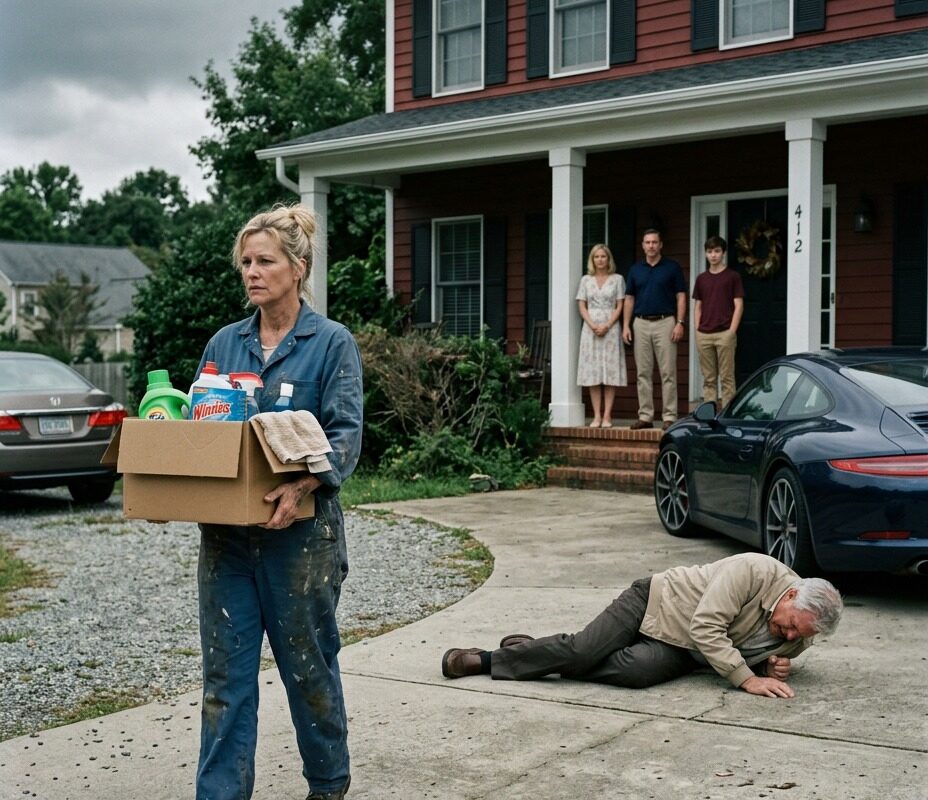
I Won $450 Million… And Kept Mopping Floors So My Toxic Family Would Never Know. For Three Years, They Treated Me Like I Was Nothing—Then Yesterday, They Kicked Me Out For “Embarrassing” Them. Today, I Came Back For My Boxes… Pulling Up In A Bugatti. My Dad Collapsed On The Lawn When He Saw Who Was Behind The Wheel—But He Still Hasn’t Heard What I Came Back To Say.
My father was laughing on the lawn when the Bugatti turned onto Alder Crest Drive. It was ten minutes to ten on a bright Thursday morning, the kind of polished…
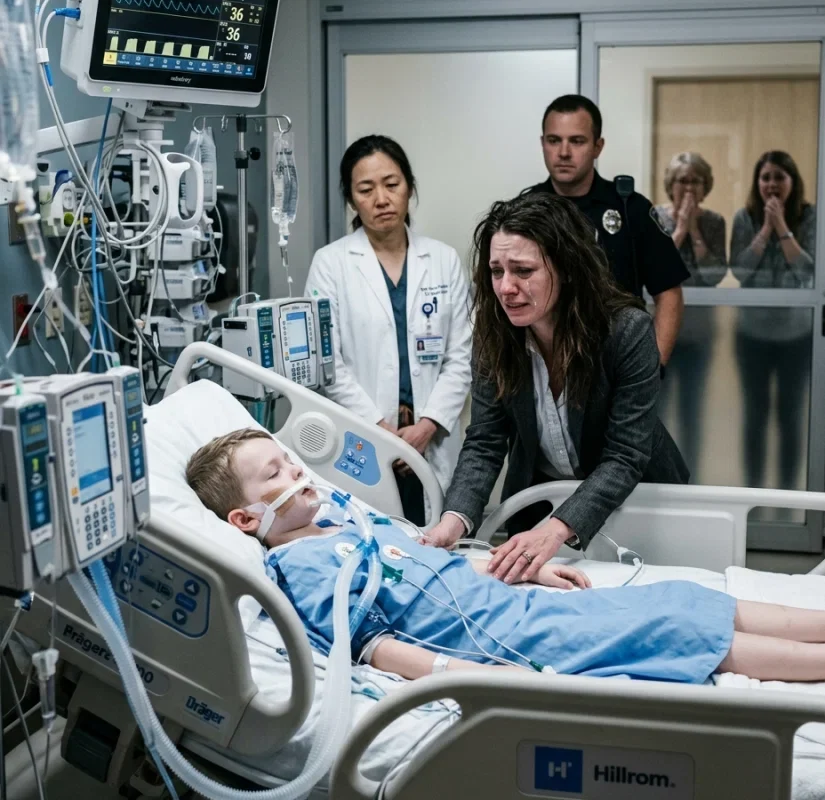
I Left My 6-Year-Old Son With My Mom And Sister Over Thanksgiving, Trusting He’d Be Safe. That Night, The Hospital Called—Critical Condition. When I Called Them, My Mom Laughed… My Sister Said He “Deserved It.” I Said Nothing. I Just Got On The First Flight Back. But The Next Morning, When They Walked Into His Hospital Room… They Both Started Screaming.
1. The Red-Eye to Hell The cheap, thin curtains of the Denver airport hotel room did little to block the harsh orange glow of the streetlights outside. The digital clock…
After my parents passed, my brother locked me out of the house. At the will reading, he said, “Hope you enjoy starting over, because I made sure you get nothing.” Then the lawyer said, “There’s one final section…” – Part 2
But the program was expensive, and between my student loans and my barely there savings, it had always seemed like a distant dream. Now I could afford it. I used…
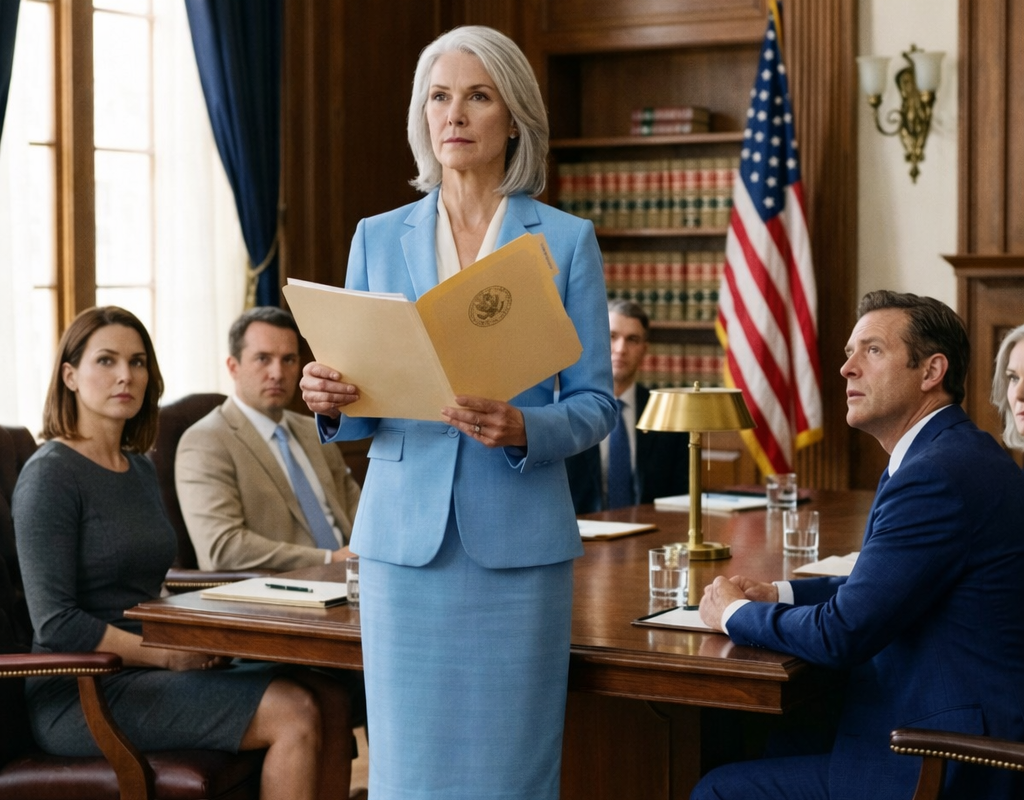
After my parents passed, my brother locked me out of the house. At the will reading, he said, “Hope you enjoy starting over, because I made sure you get nothing.” Then the lawyer said, “There’s one final section…”
After My Parents Died, My Brother Kicked Me Out Of The House, But At The Will Reading… My name is Briana Mercer and I have endured 32 years in a…
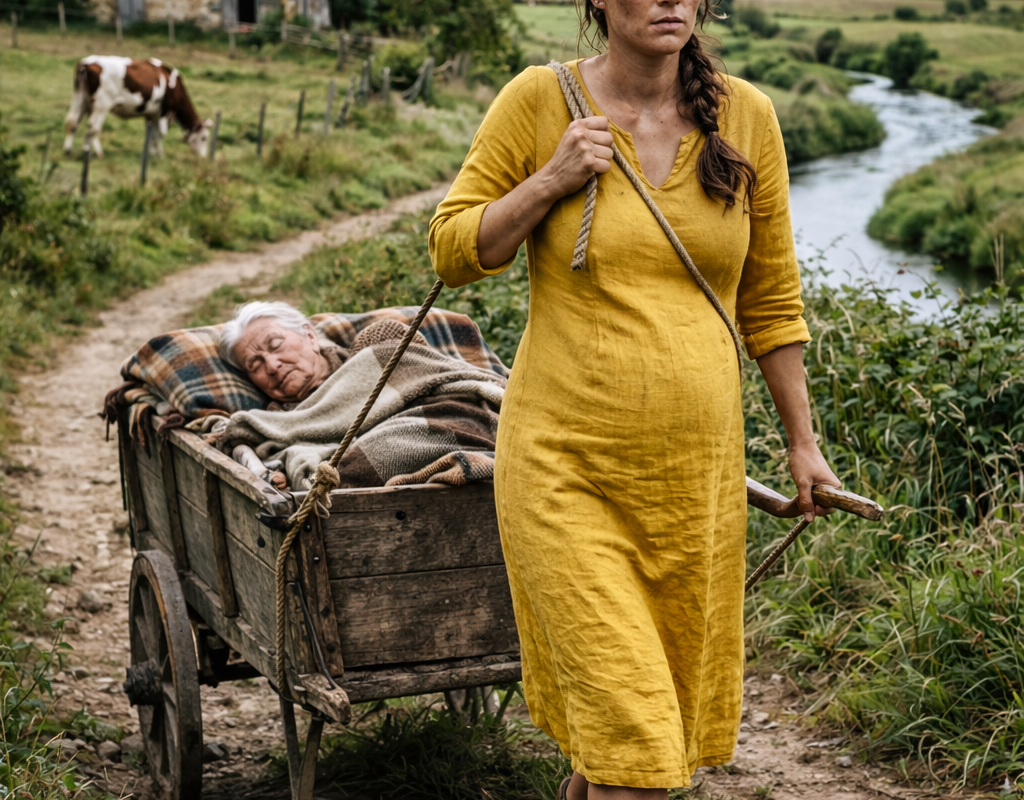
Hunted and pregnant, she agrees to treat the “crazy” woman of the family… But the heavy secret she will discover will blow up the whole city.
Chloe was clutching her 7-month-old baby bump, tears streaming down her pale cheeks. The echo of her mother’s voice still echoed in the cramped suburban apartment where she had grown…
End of content
No more pages to load