“My father drove away without me on graduation day,” I said—and that was the night they threw me out for good.
My name is Talia Mercer, and the night my father let his wife throw me out, I stopped being anyone’s daughter.
My mother died when I was ten. For a while, it was just my father and me, two people grieving in the same small house, trying to pretend we still understood how to live in it. Then he married Veronica Hale. She arrived with polished smiles, expensive perfume, and a daughter named Celia who was my age and knew how to act helpless whenever adults were watching.
Everything changed within months.
Celia got the bigger bedroom, new clothes every season, and birthday parties with matching decorations. I got chores. Then more chores. Then rules that applied only to me. I washed dishes, scrubbed floors, folded laundry, cleaned bathrooms, and learned how to stay invisible. Veronica said it built character. My father said nothing at all.
That silence was the worst part.
Cruelty from a stepmother is obvious. But watching your own father look away while it happens teaches you a different kind of pain. It teaches you that abandonment can happen in installments. First your comfort. Then your voice. Then your place in the family.
I slept on a thin mattress on the floor of the laundry room while Celia complained if her room got too warm. I worked after school at a grocery store to pay for school supplies, lunch fees, and later part of my own tuition. Veronica liked telling people I was “independent.” What she meant was unpaid and unwanted. My father let her tell that story because it made his cowardice sound like parenting.
By the time I reached graduation, I had learned not to expect pride, kindness, or even basic fairness. Still, some childish part of me believed that day might be different. I had finished school with honors despite everything. I bought my own dress from clearance racks and ironed it myself in the kitchen before sunrise. For a few foolish hours, I let myself imagine my father might look at me and see something worth claiming.
He didn’t.
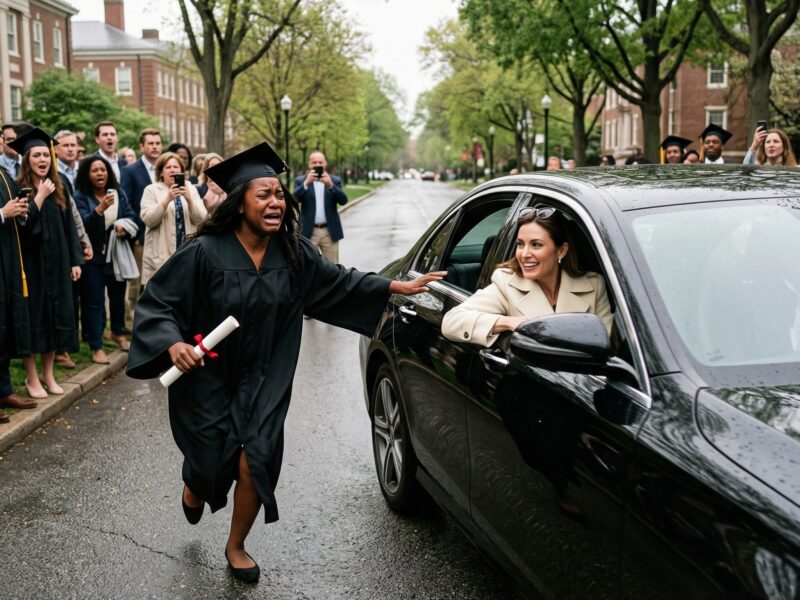
There was room. I could see it.
I looked at my father. He gripped the wheel and stared straight ahead.
Then he started the engine

They drove away while I stood there in my graduation shoes, holding a paper diploma and feeling more foolish than I ever had in my life. I walked home under the heat of late afternoon, my feet blistering, my makeup streaked with sweat, telling myself over and over not to cry until I reached the house.
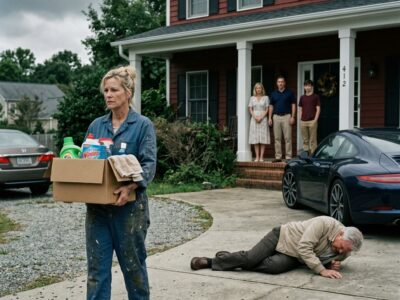
But when I got there, my suitcase was already on the porch.
A torn old duffel bag. Some clothes. A pair of shoes. Nothing more.
Veronica opened the door and said, almost cheerfully, “You’re eighteen now. Time to make it on your own.”
My father stood behind her like a shadow. Weak. Familiar. Useless.
Then he finally spoke.
“This is for the best, Talia.”
That was the sentence that killed whatever hope I had left.
So I picked up my bag, stepped off that porch, and walked into the dark with nowhere to go.
What neither of them knew was that the girl they threw away that night would survive everything that came next—and years later, I would be the one answering a phone call they never imagined they’d have to make.
Part 2
The first nights after they threw me out were the hardest because hunger is one thing, but disbelief is another.
I slept at bus stops, behind a closed laundromat once, and for three nights in the back stairwell of an apartment building where no one noticed me if I stayed quiet. I learned how to keep my bag wrapped around my arm while sleeping. I learned which convenience stores would let me use the restroom without buying anything. I learned how cold concrete feels after midnight and how quickly shame turns into discipline when survival becomes the only plan left.
I did not beg.
Not because I was proud in some noble, dramatic way. I simply knew that if I started seeing myself as helpless, I might never recover. So I worked. First washing dishes in a diner that paid cash at the end of each shift. Then mopping floors at a gym before sunrise. Then cleaning offices on weekends. I ate cheaply, slept little, and saved every dollar I could. When people pitied me, I nodded. When they underestimated me, I let them.
That became my first advantage.
Years passed. Not all at once, not neatly, but steadily. I rented a room. Then a better room. I took night classes. I learned bookkeeping because numbers were honest in ways people rarely were. That led to administrative work, then property management, then eventually my own small business helping struggling tenants and elderly homeowners organize finances, avoid scams, and keep their housing stable. Maybe that career found me because I knew exactly what it felt like to be disposable in your own home.
By thirty, I had something I never had growing up: peace. Not perfect peace. I still woke up angry sometimes. I still hated graduation season. But I had an apartment with sunlight, furniture I chose myself, and a front door no one could order me out of. That mattered more than I can explain.
Then one Tuesday afternoon, my phone rang with a number I hadn’t seen in over a decade.
I almost didn’t answer.
But I did.
And I heard my father crying.
Not sniffling. Not emotional. Crying in that hollow, desperate way people do when life has finally taken from them what they once thought guaranteed. Veronica had emptied the accounts, sold what she could, and disappeared with Celia. The house was gone. His health was failing. He was alone.
He said my name like it still belonged to him.
He asked if I could come.
I sat in silence long enough for him to understand I owed him none of this. Then I asked the only question that mattered.
“Where were you when I needed someone to come for me?”
He had no answer.
Still, I went.
Not because forgiveness had arrived. Not because blood suddenly called me home. I went because unresolved pain has a way of lingering unless you face it directly. I needed to see him with my own eyes. I needed to know whether the man who let me be erased had ever truly understood what he had done.
When I opened the door to that care facility room two days later, I barely recognized him.
And when he looked up at me and whispered, “I never thought she’d do this to me,” I realized the cruelest lesson of all:
He still thought the story began with his betrayal, not mine.
Part 3
He looked smaller than memory.
That was my first thought standing in the doorway of his room. My father, Daniel Mercer, had once filled every room in my childhood simply because I needed him to. Even his silence carried weight back then. But age, sickness, and abandonment had reduced him to a man in a wrinkled sweater sitting beside a bed he could no longer leave without help.
For one long second, I saw two people at once.
The man in front of me.
And the father who started the car and drove away from my graduation.
He reached for my hand when I came closer. I didn’t take it.
“I’m sorry,” he said immediately, as if speed could make it more sincere. “Veronica lied to me. She manipulated everything. I was trying to keep peace.”
I almost laughed.
That phrase. Keep peace. I had heard versions of it my whole childhood. Men like my father call it peace when they choose comfort over courage. They call it avoiding conflict when what they are really avoiding is responsibility.
“You watched her treat me like a servant,” I said. “You watched her strip me out of my own home one rule at a time. Then you let her put my bag on the porch.”
His eyes filled. “I know.”
“No,” I said. “You know now because she did it to you.”
That landed.
For the first time, he stopped performing regret and actually listened.
I told him the truth plainly. That he had not lost me when Veronica stole his money. He had lost me the first time he chose silence over protection. The first time he decided his daughter’s pain was easier to tolerate than his wife’s anger. That every year I survived without him had taught me something important: love without action is just decoration.
He cried harder after that. Maybe from guilt. Maybe from loneliness. Maybe simply because there was no one left to lie to him, including himself.
I did not scream. I did not insult him. I had imagined revenge when I was younger, but real adulthood had taught me that vengeance rarely heals what neglect breaks. What I wanted was closure, not cruelty.
So I gave him what I could live with.
I met with the facility director, reviewed his care options, and arranged for him to move into a better long-term nursing home where his medical needs would be handled properly. I paid the first year in full. I made sure he would be safe, fed, supervised, and treated with dignity.
But I also made my boundaries clear.
“I’m not doing this because we’re a family again,” I told him on my last visit before the transfer. “I’m doing it because I refuse to become the kind of person who abandons someone helpless. That cycle ends with me.”
He nodded like a man receiving a sentence he had already known was coming.
I did visit once more months later. Briefly. Politely. By then he seemed quieter, less defensive, almost relieved that I had told him the truth instead of offering fake reconciliation. We talked about the weather, my business, and a book he was reading. Nothing deeper. Some wounds do not close into love. They close into distance you can survive.
Veronica and Celia never came back. I stopped expecting justice to look like punishment. Sometimes justice is simply refusing to let your suffering define the rest of your life.
That is what I built instead.
A business. A home. A self no one can evict from her own worth.
My father once told me being thrown out was “for the best.” In a twisted way, he was right. It forced me to become someone no cruelty could finish destroying.
And that, finally, is the part of the story that belongs to me.
If this story touched you, share it, follow along, and remember: survival is powerful, but healing on your own terms is freedom.